
A neglected aspect of the story of Noah is his birth. When Noah was born, his father “called his name Noah (rest), saying ‘this one will console us over our work and the pain of our hands from the ground which Yahweh cursed.’ ” (Gen 5:29) This clear allusion back to the curse of Genesis 3 expresses and exasperated hope for fulfillment to the promise of Genesis 3:15–that God would send the seed of the woman to finally crush the serpent’s head and reverse the curse. Lamech expressed hope that Noah, whose name means rest, would finally bring about rest from the curse God put on the ground. Now while in the story of Noah and the ark we do not see Noah become this savior, and in fact at the end of chapter 9 of Genesis we see him disqualified form being this savior, the idea of God’s rest must somehow be connected with Noah. This is for a couple reasons: his name, and his salvation by God. But then, why does the author of Hebrews ignore the story of Noah in writing his exhortation to enter God’s rest in Hebrews 4?
Tag: Bible: Commentary, Intertextuality, Exposition
Wordplay, the Flood, and God’s Judgment of Sin
Noah’s Ark is told as a children’s flannel-graph story, with cartoon animals, a cheerful Noah, and a stylized rainbow decorating baby’s rooms and storybook Bibles. However, the story of the flood provides a devastating description of God’s hatred and wrath expressed against pervasive, rampant human sin. The Babylon Bee has capitalized on this irony multiple times. As you read Genesis 6:5–22, in which God describes the reasons for the flood and commissions Noah to build an ark for his own salvation, several instances of wordplay reveal the nature of sin and the nature of God’s judgment on sin. This occurs along the lines of two themes: God’s grief over sin and sin’s corruption of creation.
Continue reading “Wordplay, the Flood, and God’s Judgment of Sin”
Cain and Abel: Humanity Can’t Save Itself from Sin
The Sunday School story of Cain and Abel has historically been put to many uses. As children, some of us probably heard it presented as a moral tale to discourage us from fighting with our siblings. In the biblical counseling world, the falling of Cain’s countenance (Gen 4:5–7) is used as a proof that emotions and conditions within the inner man can affect the outer man. Cain’s declaration that his punishment is too much for him has been used to encourage people to be wise and endure the consequences of their sin. But these and similar usages of Genesis 4 miss the main point being presented in the chapter: that redemption cannot come from man. People are unable to save themselves from sin and the curse. Continue reading “Cain and Abel: Humanity Can’t Save Itself from Sin”
Eve’s Deception and Our Perception
As Christians, we daily struggle with sin and temptation. In order to fight this, we need a strong understanding of how sin tempts us to turn away from the God who saved us. We find this knowledge in the Bible, even at the very beginning. Genesis 2 and 3 show us that the reason that Eve was deceived by the serpent is the same reason that we fall into sin under temptation in our individual lives today. Parallels between Genesis 2 and 3 demonstrate the heinous evil of the sin of Adam and of all sins since.
When Heaven Helped Those who Helped Themselves
Words matter. As a self-identified writer, I at least sometimes try to pick my words intentionally so that they create specific informational and emotional effects in the minds of my readers. The biblical authors of course did the same thing. Unlike me, they wrote in Hebrew and Greek, with at least the first of these two being a heavenly language. Their specific word choices in the original languages matter. Continue reading “When Heaven Helped Those who Helped Themselves”
A Land Like Your Own Land
In 2 Kings 18, Judah was in deep yogurt. The northern kingdom of Israel had already fallen to the Assyrians. While Hezekiah was the best king of Judah since David (vv. 3-6), and even though idolatry and contraband worship at high places had been purged from the land, and despite a past successful rebellion against Assyrian hegemony, Judah was invaded by King Sennacherib of Assyria, who successfully destroyed much of the country before besieging Jerualem (vv. 13, 17), putting his general Rabshakeh in command. Rabshakeh then commenced a propaganda campaign against the soldiers of Israel, mocking their king and their God. His speech made five points (vv. 19–35, with a reprise in 19:8–13): Continue reading “A Land Like Your Own Land”
Toward a Theology of the Restroom

Some of the easiest and most common humor in our world is based on bodily functions, particularly excretion. To a lesser and milder extent, these same jokes are common in the conversations of Christians, even educated evangelicals. A common justification for these is the seemingly graphic nature of the Bible, particularly the Old Testament in the Law and histories, when discussing these sorts of topics. However, these might not actually be connected to the issue of determining appropriate humor. Looking at a couple passages will show that this is not crudeness, but actually direct glorification of God. Continue reading “Toward a Theology of the Restroom”
When Even Men Cry: Jesus Wept

Inspired by a series of comments made by various friends about my public tears, or rather the complete lack thereof, I have decided to write a brief series of posts on the issue of men crying. I feel compelled to biblically defend myself against groundless charges of being emotionless or cold. So I will. Today we’ll talk about every time Jesus cried. Next time we’ll talk about my personal philosophy of crying in its relation biblical teaching. Finally, I’ll publish a list of times I cried college, because sometimes I like writing stuff people will actually read.
I Have a Dream for Amos 5:24

Please see update I wrote to this post in 2020 here.
On August 28, 1963, Dr. Martin Luther King Jr. gave his famous speech, “I Have a Dream.” During the middle of the civil rights movement, this speech emphasized the optimism and hope that many activists held for the future. There is, however, one exception. King quoted Amos 5:24 in this context:
No, no, we are not satisfied, and we will not be satisfied until ‘justice rolls down like waters, and righteousness like a mighty stream.’
Now most of us probably think King means something like this: “We cannot be satisfied until there is fairness for the negro, and all in the nation behave rightly towards their neighbors, independent of prejudice against color.” This is what we think based on the context of the speech. Now I mean no disrespect to Dr. King and the great good done by his actions and this speech, but unfortunately, that’s not what the verse means, because the verse has to be interpreted in the context of its chapter. Continue reading “I Have a Dream for Amos 5:24”
Perverting the Means of Grace
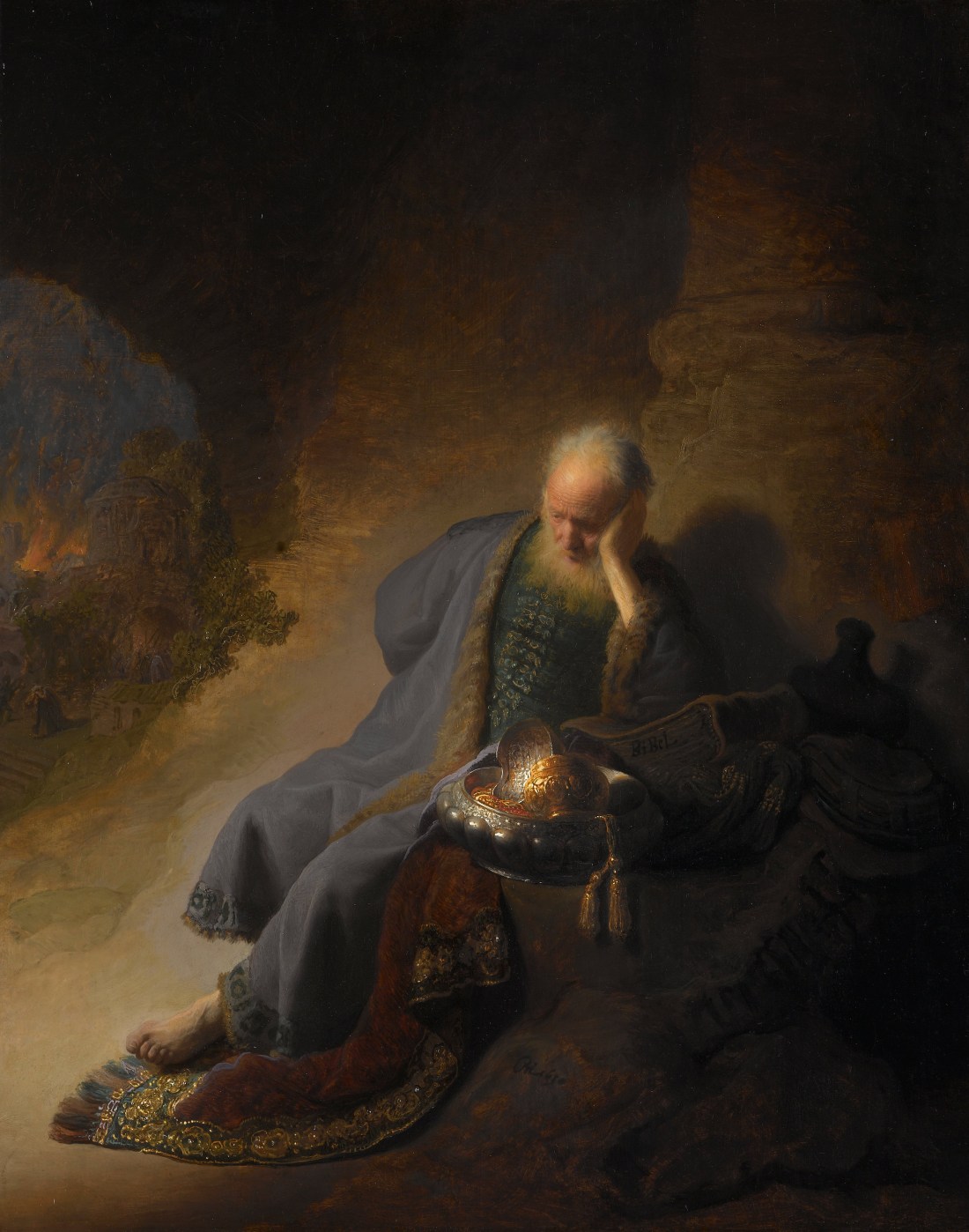
Here is one of the largest issues in the Christian life: How do you handle your personal sin? Or in one particular, how do you react when you fall? Do we attempt to make up for sin by subsequent good actions, for example Bible reading and confessional prayer? While it is quite clear that these actions do follow from a mourning of sin (1 John 1:9 essentially commands the believer to confess sins to God), in my mind I can confuse these actions as somehow atoning for my sin, somehow erasing and balancing out my past actions, somehow zeroing out debt owed to God. It is exactly this trap that the people of Judah fell into during the last years before the Babylonian captivity. Let us consider the historical record. Continue reading “Perverting the Means of Grace”
 Citizens & Sons