Why Can We Say That the Church Is Our Mother?

or, Who Is the Seed of the Woman?

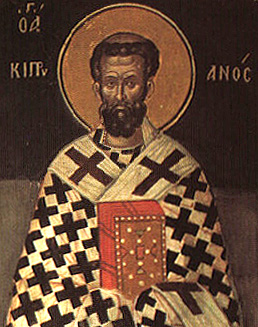
The third century North African church father Cyprian, who served as bishop of Carthage (in modern day Tunisia), made major theological contributions to topics like church unity, the doctrine of apostolic succession, and the sin of schism. One of his most famous quotes is the line “He can no longer have God for his Father, who has not the Church for his mother.” While I believe that that this sentiment has been well preserved in some traditions, for example the Roman Catholic tradition, I think on the other hand that it sounds completely foreign if not heretical to American evangelical sensibilities. Perhaps this would be for no reason other than that most of us couldn’t think of a place in the Bible that explicitly says this. Can this proposition be sustained biblically? I argue, yes, it indeed can be.

Continue reading “Why Can We Say That the Church Is Our Mother?”

Some Thoughts on the Definition of Biblical Theology

In recent years biblical theology has become increasingly popular in Christian circles. That is not to say that “the truths of the Bible” or “biblical doctrines” were unpopular and are now becoming popular, or that there has been any particular revival in the church, but rather that a certain way of doing theology is becoming more popular in pulpits, in the Christian blogosphere, and in the academy. Perhaps because of its recent growth into the limelight, many people seem confused about the definition of biblical theology, and this confusion muddies theological discussion. The cause of this is a tendency to define biblical theology in terms of its results and findings instead of its methods.

Continue Reading

Toward a Theology of the Restroom

Some of the easiest and most common humor in our world is based on bodily functions, particularly excretion. To a lesser and milder extent, these same jokes are common in the conversations of Christians, even educated evangelicals. A common justification for these is the seemingly graphic nature of the Bible, particularly the Old Testament in the Law and histories, when discussing these sorts of topics. However, these might not actually be connected to the issue of determining appropriate humor. Looking at a couple passages will show that this is not crudeness, but actually direct glorification of God. Continue reading “Toward a Theology of the Restroom”

Am I Ever Safe from Sinning?

As Christians, we all know from Romans 7–not to mention from personal experience–that we are still very sinful, and continue to do so even after God has forgiven us.  And we also hate that, or at least know we should, see again Romans 7.  We notice, as we strive to put to death the deeds of the flesh that we might live, that sin is hard to fight.  No matter how hard we fight, we still fall into sin sometimes.  The devil is indeed prowling about as a roaring lion, seeking whom he may devour.  When we hear God tell Cain that sin is crouching at his door, we feel God is really speaking to us.  And sadly, sin doesn’t stop crouching at our door just because we’re at church or are on a spiritual high or just read our Bibles or just came from the most amazing small group ever or are actively serving God on the missions field.  No matter how God centered the things around us may be, we can still sin.  We are never safe from sin.  Even–perhaps even especially–when God is directly blessing us or giving us direct experience of His presence, we can fall into sin.  This shocking truth is quite biblical.  Let’s call it the immediacy of sin.  It can be quite easily traced through the entirety of Biblical history. Continue reading “Am I Ever Safe from Sinning?”

Why You Should Wear Clothes

No Swimming
A situation in which it is advantageous to already be wearing clothes

There is a pervasive assumption I’ve noticed in conversations with many fellow believers regarding clothing: that the main purpose of clothes is to prevent sexual temptation.  Which is all well and good, except for the fact that it’s just wrong.  The assumption probably comes from the connection between modesty and the Christian philosophy of clothing, as seen here, here, and more comprehensively here.  In modern American culture, where so much of fashion is intentionally sexual, this confusion is understandable.  But given global standards of modesty, diverse to the extent some primitive cultures forego clothing almost entirely, modesty makes a poor logical rationale for wearing clothes.  You may object to so called “native nudity,” but as such attire (or lack thereof) is neither intended to arouse nor to draw attention to the individual, it fulfills the requirements of modesty.  Modesty and wearing clothes are two different things.  I don’t want to talk about modesty today, because I want to talk about the real reason we wear clothes—the gospel reason we wear clothes. Continue reading “Why You Should Wear Clothes”