
Evangelicalism has another sex scandal afoot, as is endemic to American evangelicalism at this point. Every time this happens, the weird excuse that somehow the godly David fell accidentally into sexual sin with Bathsheba circles again as a means to distract from the impact of a major speaker on the reformed-ish conference circuit’s extramarital affair. It’s worth wondering how David as the man after God’s own heart could fall into gross sin, right? Except that the idea that David was somehow the godliest man in the Bible suffers from a lack of exegetical support.
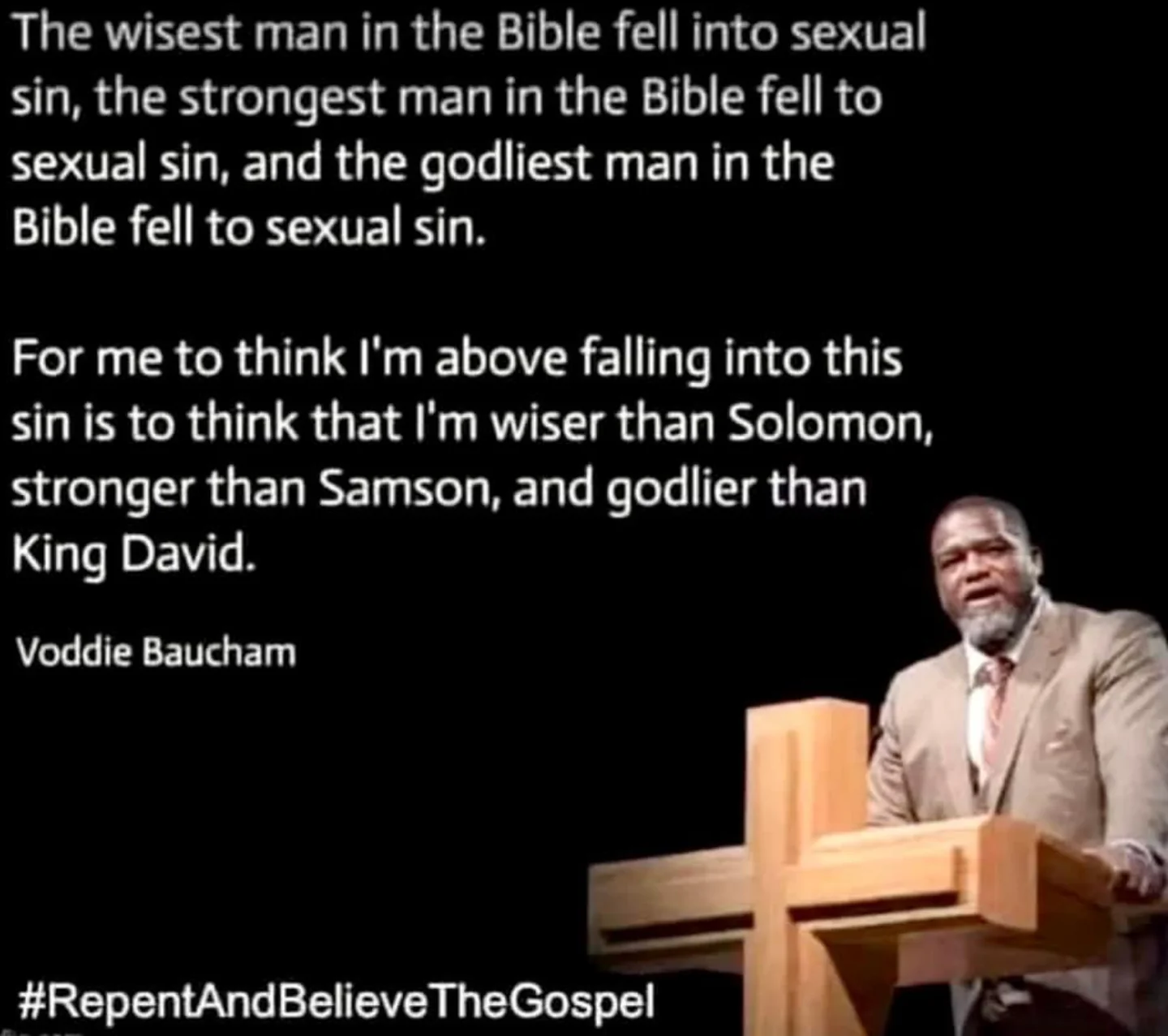
We’re not here to talk about Samson or Solomon today. The idea that David is the godliest man in the Bible is usually rooted in a quote from 1 Samuel 13:14, repeated in Acts 13:22, which I will here give you from the King James Version:1
But now thy kingdom shall not continue: the Lord hath sought him a man after his own heart, and the Lord hath commanded him to be captain over his people, because thou hast not kept that which the Lord commanded thee. (1 Sam 13:14)
And when he had removed him, he raised up unto them David to be their king; to whom also he gave their testimony, and said, I have found David the son of Jesse, a man after mine own heart, which shall fulfil all my will. (Acts 13:22)
Generally this has become assumed to be a statement about David’s moral character. It is not. Very basic errors have been made because of (valid and understandable) attempts to translate the Greek and Hebrew of the two passages as closely as possible to the grammatical constructions in the original texts. Here are copies from Biblia Hebraica Stuttgartensia and Nestle-Alland 28th Edition (of the Greek New Testament):
וְעַתָּ֖ה מַמְלַכְתְּךָ֣ לֹא־תָק֑וּם בִּקֵּשׁ֩ יְהוָ֨ה ל֜וֹ אִ֣ישׁ כִּלְבָב֗וֹ וַיְצַוֵּ֨הוּ יְהוָ֤ה לְנָגִיד֙ עַל־עַמּ֔וֹ כִּ֚י לֹ֣א שָׁמַ֔רְתָּ אֵ֥ת אֲשֶֽׁר־צִוְּךָ֖ יְהוָֽה׃
καὶ μεταστήσας αὐτὸν ἤγειρεν τὸν Δαυὶδ αὐτοῖς εἰς βασιλέα ᾧ καὶ εἶπεν μαρτυρήσας· εὗρον Δαυὶδ τὸν τοῦ Ἰεσσαί, ἄνδρα κατὰ τὴν καρδίαν μου, ὃς ποιήσει πάντα τὰ θελήματά μου.
The relevant part from the Hebrew could be transliterated as follows:
biqesh YHWH lo ish kalebabo / YHWH will seek for himself a man according to his heart
(1 Sam 13:14)
The reference in Acts 13:22 is making a quotation from the Septuagint (Greek) translation of 1 Samuel 13:14, which could be transliterated as anthrōpon kata tēn kardian autou (a man according to his heart). The Greek of the New Testament seems to reflect a word for word translation of whatever this Hebrew idiom means. What’s odd is that the King James translators in rendering it “after God’s own heart” seem to stay closer to the Greek construction than the Hebrew construction; Biblical Hebrew’s preposition ke- simply is not used with the idea of after or succession, but rather comparison or conformity (hence according to). The King James rendering suggests to modern readers in the idea after that David actively followed after God’s heart, whereas the Hebrew expression might actually indicate the opposite, that David as a man was chosen according to the intentions of God’s heart.
But this is a Hebrew idiom! It cannot be interpreted as just an English “man after God’s own heart” with the idea that David somehow reflected the character of God. That is not how Hebrew uses lebab (heart) in the vast majority of relevant places. In fact, a similar expression im lebab/”with heart” (compare to the prefixed preposition ke– at issue here) is used to express the idea of intention or desire, such as the desire of David to build the temple (e.g. 1 Kgs 8:17; 2 Chr 6:7). King Joash is also described as desiring to renew the temple with the similar term im leb/”with heart” (2 Chr 24:4). Such expressions make sense because in general, leb/lebab for heart refers not to the idea of character but to whole inner life; biblical characters are said to say things in their heart as a means of describing their internal monologue (e.g. Jeroboam in 1 Kgs 12:26). The heart is the center of thoughts. A similar usage best fits 1 Samuel 13:14. That is, David is picked as the man that God chooses or desires or sets his intention on for kingship. This does not constitute a proof of David’s moral character.
Such a reading fits the context of the Saul-David stories. Saul was the people’s choice through a long process which Samuel resisted (1 Sam 8-12), a choice the reflected a rejection of YHWH as king. David, introduced now indirectly in 1 Samuel 13:14, represents YHWH’s counter-choice (rather than reappointing himself as directly theocratic king again, so to speak, over Israel). In this context, such a choice hardly requires David have upstanding moral character. This additionally fits the description of the famous event at which Samuel seems to anoint David despite outward appearances in 1 Samuel 16. After all, “Man looks at outward appearance, but YHWH looks at the heart” (1 Sam 16:7). But such an explanation of this being about David’s character runs afoul of the rather obvious point that David’s appearance is described in positive terms (1 Sam 16:12). David’s background as a shepherd reflected the Assyrian mythos of kings as shepherds of the people, thereby rather underscoring through literal interpretation of an Ancient Near Eastern ethos that David was more qualified as a king than Saul. David’s acceptance by the people as having slain his 10,000s, in comparison to Saul’s 1000s (1 Sam 18:7), indicates that David distinguished himself by the things people look at quite quickly. David then spends time with the Philistines rather than defending Israel, after managing to take another man’s wife (polygamously we might add) conveniently after his death (1 Sam 25) while gathering a following of outcasts mixed with ne’er-do-wells (1 Sam 22:2) that ultimately become the military men of his kingdom. But for whatever reason, God chose him, and YHWH offered David and his descendants a covenant for continued reign (2 Sam 7), a dynasty preserved until 586 BC rather in spite of David’s actions or character.
The description above avoids all the failures of David during his actual kingship. Despite the wonderful Psalms associated with David throughout the Psalter, the failures during his reign and the complexities of his rise to power suggest that we should be very slow to rate David as the godliest man of the Old Testament (let alone the Bible) above, say, Enoch or Job or Hezekiah or Josiah or (ironically) Uriah. That God chose David, that it was God’s desire and intention to choose David, does not imply anything about David’s character. That David was a man after/according to God’s own heart has only to do with the sovereign choice of YHWH. And that choice was a mysterious one.
There are some lessons here. It’s worth questioning “common sense” received wisdom about biblical narratives and biblical texts, especially in evangelicalism, as such is often used to reinforce certain power dynamics (What does comparing a pastor in sin to King David say about the fallen pastor in terms of his power and influence and importance? Why compare the pastor to a Psalm-writer?) rather than necessarily interacting with the actual meaning of the text itself. Read good commentaries. Ask good questions. Be skeptical of surface level interpretation off of translations, especially the King James Version. Avoid the idea that people in the Bible are intended to be moral exemplars. Be aware that conference speakers are just popular entertainers fulfilling the desires of their audiences even when they are called pastors or expositors. There are some basic but sadly still necessary lessons here.
1 Examples include (all accessed September 25, 2024): Got Questions, Bible Study Tools, Bible Daily.
And strangely, even those who see the grammatical issues I identify somehow get caught up in assuming that if God sovereignly chooses David as king that must reflect something about David’s spiritual qualifications, like my fellow TMS alum Peter Goeman.
I also sadly have to throw Chuck Swindoll under the bus here too because of his David, A Man after God’s Own Heart: A Bible Study Guide (1988):


 Citizens & Sons